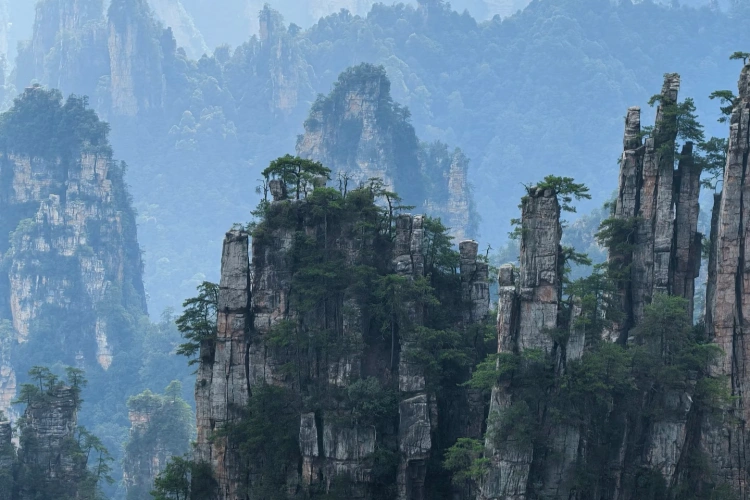
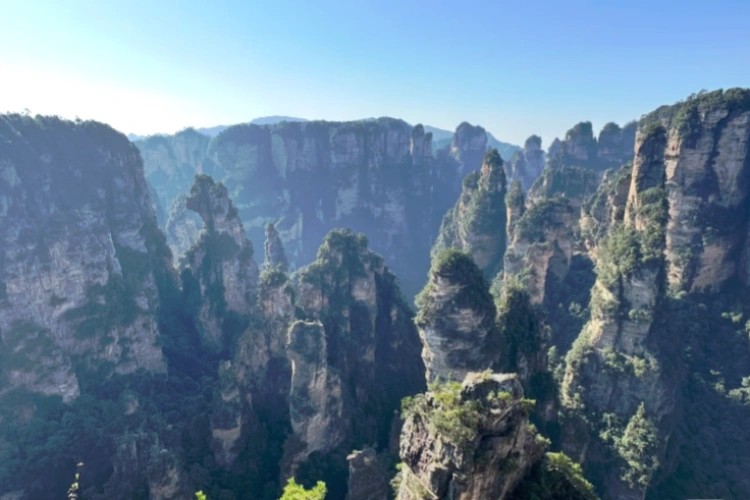
If you stand at the edge of the Yuanjiajie plateau, the view feels like a glitch in the Earth’s geometry. Thousands of slender, vertical pillars rise from the forest floor, some soaring over 1,000 feet into the mist. While these landscapes look like a gravity-defying dream, understanding how the Zhangjiajie mountains form requires looking back through 380 million years of “patient destruction.”
It is easy to see why James Cameron’s team used this landscape as the primary inspiration for the floating mountains of Avatar, but the real magic lies in the rare geological category known as the Zhangjiajie Landform.
While many travelers mistake these for the rounded “karst” mountains found in Guilin, Zhangjiajie is something far more resilient. It is a Quartz Sandstone Peak Forest, and its birth is a story of three distinct acts.
Act I: The Ancient Seabed (380 Million Years Ago)
The story begins in the Devonian Period. At that time, what we now call Zhangjiajie was a shallow sea. Over millions of years, rivers carried vast amounts of sediment from nearby continents into this basin.
The “secret ingredient” of Zhangjiajie is Quartz Sandstone. The sediment that settled here was incredibly rich in silica (quartz), with a purity of 75% to 95%. This high quartz content acts as a natural reinforcement. Unlike limestone, which dissolves easily in water, quartz sandstone is exceptionally hard and resistant to chemical weathering. This strength is precisely what allows the pillars to stand so tall and thin without collapsing.
Act II: The Great Uplift (Tectonics)
Around 100 million years ago, tectonic movements, specifically the collision of the Indian and Eurasian plates, began to push the seabed upward. This turned the ancient underwater layers into a high, flat plateau.
As the rock rose, it didn’t just stay in one piece. The stress of the uplift caused the sandstone to develop vertical joint sets (long, vertical fractures). Think of a giant block of chocolate that develops perfectly straight cracks when you twist it. These cracks became the “blueprints” for the future pillars.
Act III: The Chisel of Water and Wind
Once the plateau was exposed, the subtropical climate of Hunan took over. High humidity, heavy rainfall, and freeze-thaw cycles turned the vertical cracks into channels for erosion.
This process followed a specific evolutionary sequence that you can still see today in different parts of the park:
Plateau: The original flat surface (like Yellow Stone Village).
Peak Walls: Water cuts deep, leaving long, thin ridges (like the “Natural Great Wall” in Yangjiajie).
Peak Forests: The walls are sliced further into clusters of towers (seen in Tianzi Mountain).
Pillars: Individual, solitary columns, the iconic “Avatar” mountains (found in Yuanjiajie).
Why Isn’t This a “Karst” Landscape?
It is a common error to call Zhangjiajie a “karst” landscape. In geology, words matter:
Guilin (Karst): Made of Limestone. It is shaped primarily by chemical dissolution: water literally dissolves the rock, leading to rounded humps and vast caves.
Zhangjiajie (Sandstone): Made of Quartz Sandstone. It is shaped by physical erosion: water, wind, and gravity physically carve away the stone. This results in sharp, angular edges and vertical walls that limestone could never sustain.

The Living Sculptor: The Wuling Pine
The final touch to Zhangjiajie’s formation is biological. The Wuling Pine (Pinus henryi) is remarkably resilient. These trees grow directly into the vertical cracks of the sandstone.
Their roots act like slow-motion wedges, expanding the cracks over centuries. Ironically, the same trees that make the mountains look so lush and “alive” are also the ones slowly breaking them down. When the mist rolls through the valley and hides the bases of these pine-topped towers, the illusion of “floating” is complete.
Where to Witness the Formation Today
If you want to see the “evolutionary map” of Zhangjiajie during your visit, head to these three spots:
Yangjiajie: To see the “Peak Walls”: the middle stage where the plateau is just beginning to separate.
Tianzi Mountain: To see the “Peak Forest”: the stage where clusters of thousands of peaks stand together.
Yuanjiajie: To see the final stage: the “Solitary Pillars” that stand as isolated, gravity-defying monoliths.
FAQ
Are the mountains still changing?
Yes. Erosion is a constant process. While we can’t see it with the naked eye, the pillars are becoming thinner every year. Eventually, they will collapse into “remnant peaks” at the valley floor.
Can I find fossils here?
Yes! Because the rock was once a seabed, you can occasionally find marine fossils (like ancient corals or shellfish) embedded in the sandstone layers.
Is it safe to walk on the glass bridge if the rock is eroding?
Absolutely. The engineering of the Glass Bridge and the Bailong Elevator is anchored into the most stable sections of the bedrock, and the rate of natural erosion is measured in millimeters per century.