If you are planning your first trip to China, you have probably heard about its nearly cashless society, and that’s absolutely true. From my own experience, I haven’t carried a wallet for years and have almost forgotten what paper money even looks like (just joking… kind of).
Whether you’re buying a bottle of water, taking a Didi ride, paying for a metro ticket, or shopping at a local market, you’ll quickly notice that most people simply pull out their phones, instead of cash, and scan a QR code.
For years, figuring out how to pay in China as a tourist was a real headache. But thanks to major improvements in recent years, the whole system has become much more foreigner-friendly and much easier to navigate.
In this guide, you’ll learn the main payment methods in China and how to use them like a local. Besides, we’ll also walk through setup steps, transaction fees, and practical tips to help you save money and avoid common mistakes.
Note: Get our FREE Alipay and WeChat Pay setup guide (PDF) and learn how to set up your account, link your card, and make your first payment in just a few minutes.

Best Payment Methods in China
If you want the best payment method in China as a foreigner, look no further than Alipay and WeChat Pay. Together, these two digital wallets handle over 90% of daily transactions in the country.
The good news is, as a foreign traveler, you do not need a Chinese bank account or a local SIM card anymore. Let’s look at the details.
1. Alipay
Alipay is China’s largest mobile payment platform and one of the easiest payment methods for foreign visitors. Thanks to its dedicated international version (Alipay+) and a clean, well-designed English interface, it has become the most reliable and widely used payment option for travelers in China.
How to Set Up Alipay
Step 1: Download the Alipay app from the App Store or Google Play.
Step 2: Register using your mobile phone number.
Note: You may be asked to verify your identity by uploading a copy of your passport. This is a standard security procedure required for payment services and is completely safe. Verification usually only takes a few minutes.
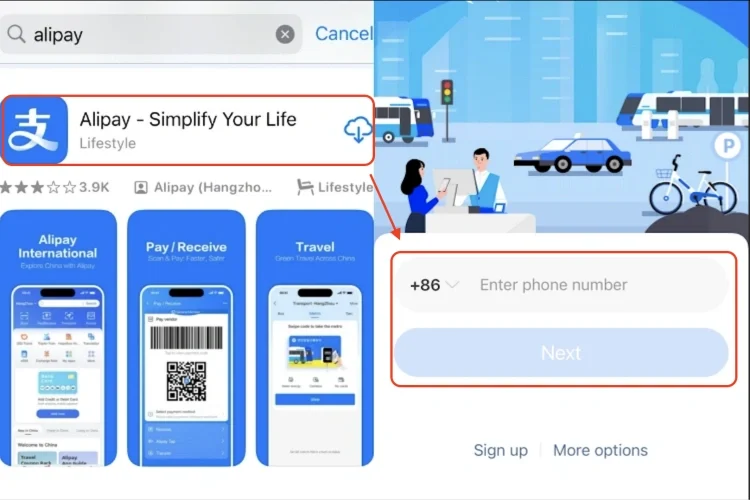
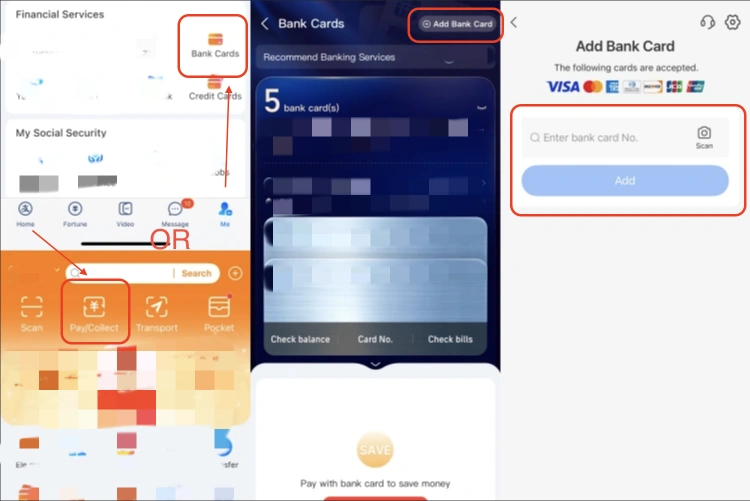
Step 3: Add your international bank card.
You have two ways to add your card: from the home screen, go to Home Screen > Pay/Collect > Add a Card; or go to Me > Bank Cards > Add Bank Card.
Then, you can either enter your card details manually or tap “Scan” to capture the card information automatically using your phone’s camera. Once you’ve entered the required details, tap Add to complete the setup.
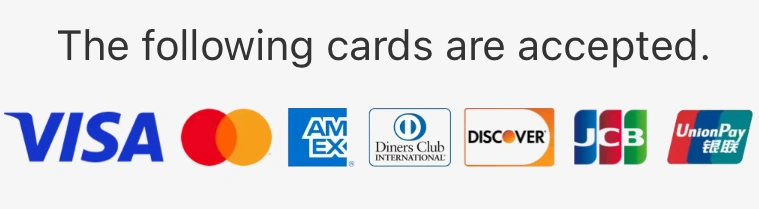
Alipay currently supports major international card networks, including Visa, Mastercard, JCB, Diners Club, Discover, and American Express.
QuietRoutes Tip: Do this before you leave home. It’s much easier to receive the SMS verification codes while you’re still on your home network!
How to Pay with Alipay
There are two main ways to pay with Alipay:
Option 1: Scan and Pay
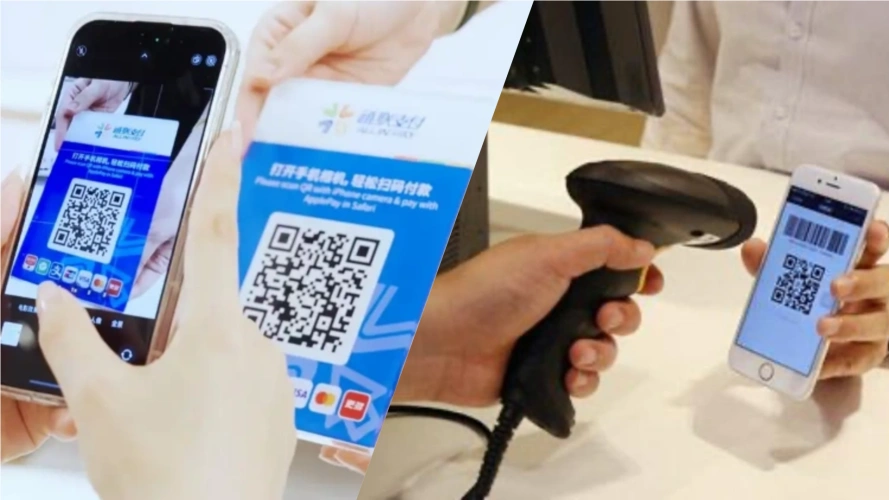
Open your Alipay, tap the “Scan” icon in the top left, point your camera at the merchant’s printed QR code sticker, enter the amount in RMB, and confirm.
This method is common in small shops, restaurants, markets, and taxis.
Option 2: Present and Pay
Open your Alipay, tap “Pay/Collect” at the top to generate your personal QR code. Present this to the cashier, who will scan it with their POS terminal. Payment is completed instantly.
This is common in supermarkets, chain stores, metro stations, and larger businesses.
QuietRoutes Tip: In our experience helping international travelers across China, Alipay tends to be the easiest payment platform for first-time visitors. It integrates smoothly with many travel-related services, including booking high-speed train tickets, hailing a Didi (China’s Uber), or using the “Transport Code” for subways, and is widely accepted throughout the country.
2. WeChat Pay
WeChat Pay is the payment system built into WeChat (known locally as Weixin), China’s most popular messaging app. Many Chinese people use WeChat Pay as their primary payment method.
For foreign visitors, it’s great if you’re already using WeChat to talk to friends or guides. However, compared with Alipay, its setup can sometimes be slightly trickier with foreign cards.
Overall, it works very well as either a main payment method or a backup to Alipay.
How to Set Up WeChat Pay
Step 1: Download the WeChat app from the App Store or Google Play.
Step 2: Register using your phone number.
Note: Similar to Alipay, you may also be asked to verify your identity by uploading a copy of your passport, which is standard and safe.
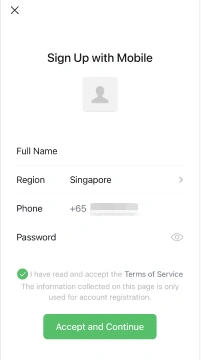
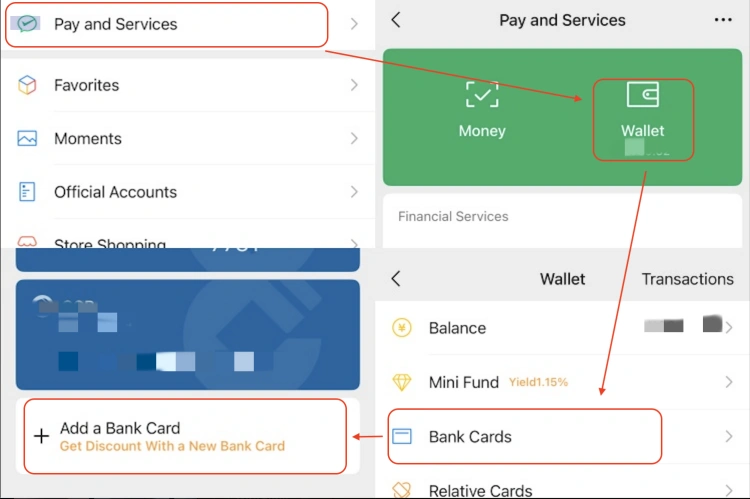
Step 3: Activate WeChat Pay by adding your international bank card.
Go to Me > Pay and Services > Wallet > Bank Cards > Add a Bank Card.
You can add an international card by entering the bank name or card number manually, or by scanning the card automatically via the camera icon on the right end.
At present, WeChat Pay supports the following international cards: Visa, Mastercard, American Express, Discover, JCB, and Diners Club.
How to Pay with WeChat Pay
Like Alipay, there are two methods:
Option 1: Scan and Pay
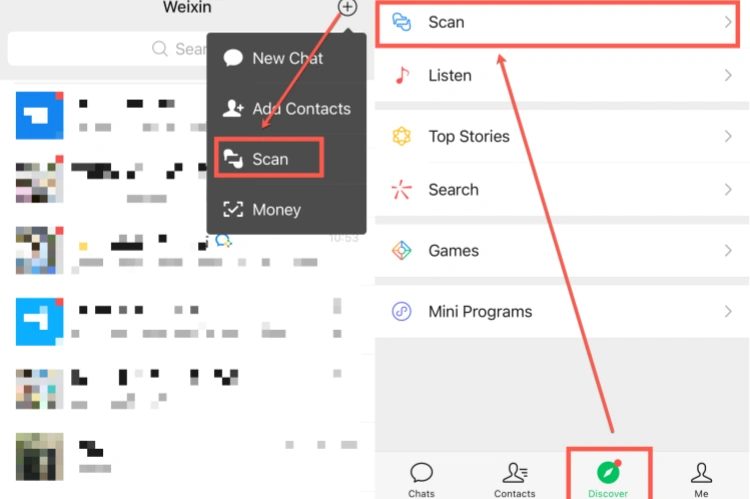
Open WeChat, tap the Plus (+) icon in the top right, and tap “Scan“, or go to Discover > Scan, then scan the merchant’s QR code, enter the amount in RMB, and confirm.
Option 2: Present and Pay
Tap Me > Pay and Services > Money, then show the generated personal QR code to the merchant or present it to the cashier.
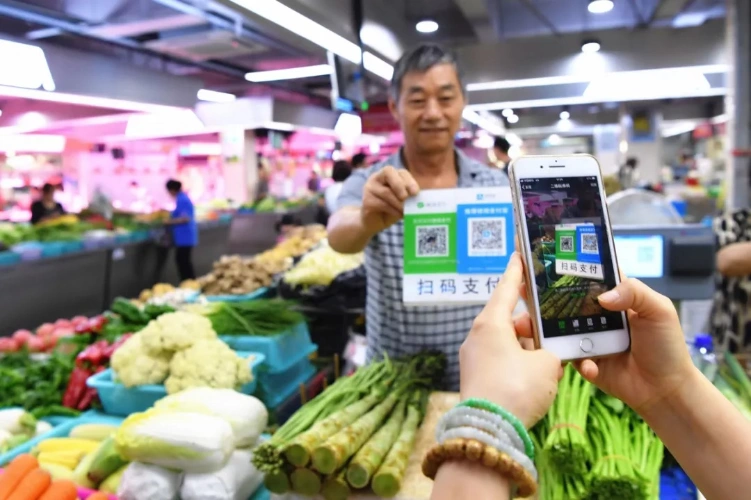
QuietRoutes Tips: Some peer-to-peer functions, money transfers, and certain financial services on WeChat Pay may still be limited for overseas users.
However, according to our experience, for normal travel spending, most tourists experience few issues.
Because some merchants occasionally prefer one platform over the other, we strongly recommend installing both Alipay and WeChat Pay before your trip.
3. Credit Cards
Can you use credit cards in China?
Yes, but their acceptance is limited compared to mobile payments.
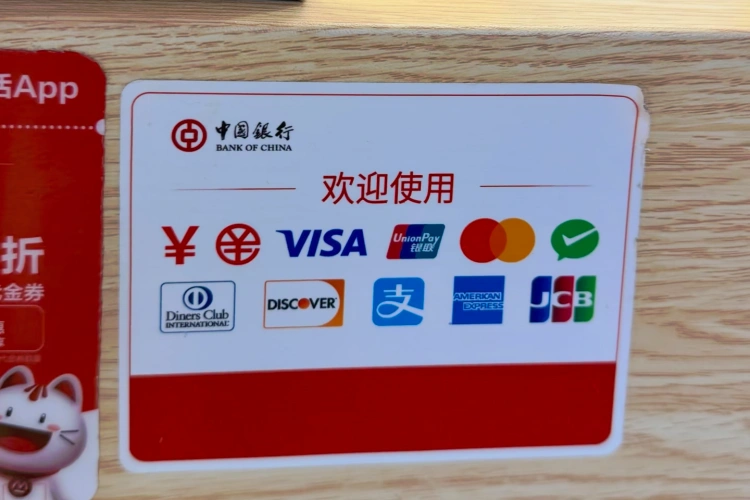
While Alipay and WeChat Pay dominate everyday transactions in China, traditional payment methods such as Visa, Mastercard, and other international credit cards are still accepted in certain places.
You can typically use international credit cards at:
- International hotel chains
- Upscale and luxury hotels
- High-end restaurants
- Luxury boutiques and shopping malls
- Large multinational supermarkets
- Airport stores and duty-free shops
However, many local businesses, including neighborhood restaurants, convenience stores, small shops, taxis, and some public transportation services, primarily rely on QR code payments through Alipay or WeChat Pay. In these situations, card acceptance may be limited or unavailable.
QuietRoutes Tip: Before traveling to China, inform your bank that you’ll be using your card overseas. Some banks may flag your first transaction in China as suspicious activity, especially during the initial 3D Secure verification process. A quick travel notice can help prevent unexpected card declines during your trip.
4. Cash
Is cash still accepted in China?
Yes. In fact, effective February 2026, national regulations strictly mandate that all physical merchants must accept RMB cash.
However, cash is no longer the preferred payment method in most cities. Many younger staff members rarely handle cash.
How Much Cash Should You Carry?
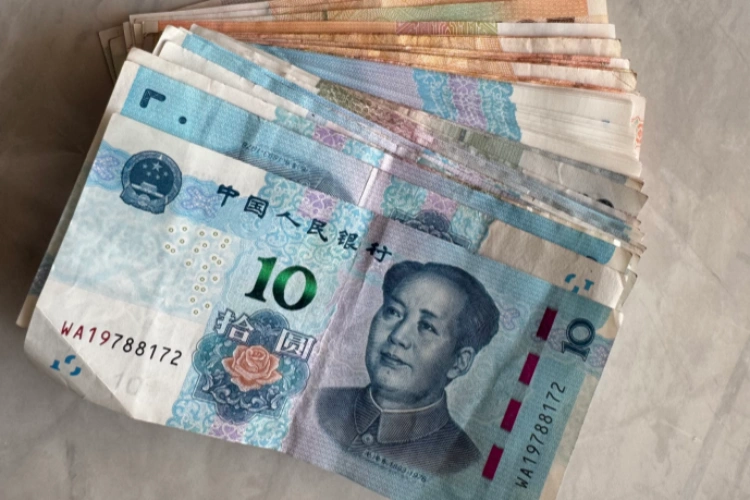
You generally don’t need to carry large amounts. For most travelers, 500–1000 RMB is usually enough as emergency cash. You can withdraw at the airport or major bank ATMs (Bank of China, ICBC) upon arrival.
Besides, it’s better to bring small notes (10 RMB, 20 RMB, 50 RMB) than large notes (100 RMB).
Large notes can sometimes be inconvenient for very small purchases because merchants may not have enough change to give you.
When Is Cash Useful?
Cash can still be helpful for rural areas, small family-run businesses, local markets, emergencies like your phone being out of battery, as well as tipping private guides and drivers.
5. PayPal
Can you use PayPal in China?
Yes, as if you’re a U.S. PayPal user.
For many years, PayPal was not a practical payment option for travelers in China.
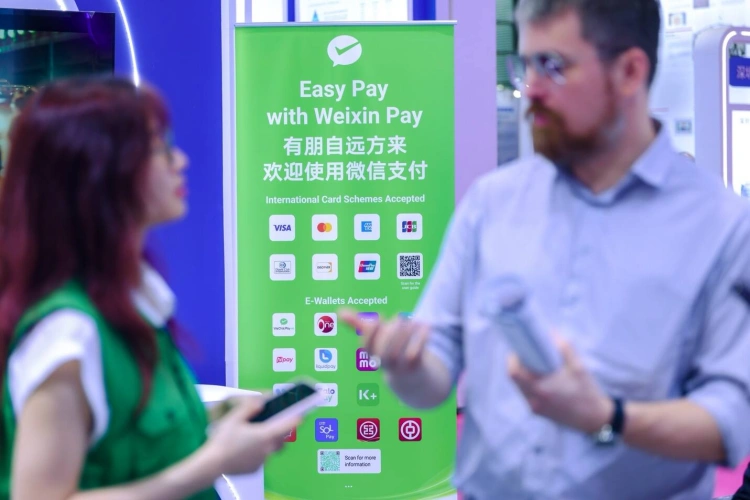
That changed in May 2026 when Tenpay Global and PayPal World announced a partnership that allows eligible U.S. PayPal users to pay at merchants that accept Weixin Pay (WeChat Pay) QR-code payments in China.
This means that U.S. travelers can use their existing PayPal accounts to make cashless payments at millions of Weixin Pay merchants across the country, without opening a Chinese bank account.
While the service is still relatively new, it represents a significant step forward in making China more accessible for international visitors.
QuietRoutes Tip: If you’re from the United States and already use PayPal regularly, it’s worth checking whether your PayPal account supports PayPal World payments before your trip. However, we still recommend setting up Alipay or WeChat Pay as your primary payment method, as they remain the most widely used payment platforms in China.
6. What about Apple Pay?
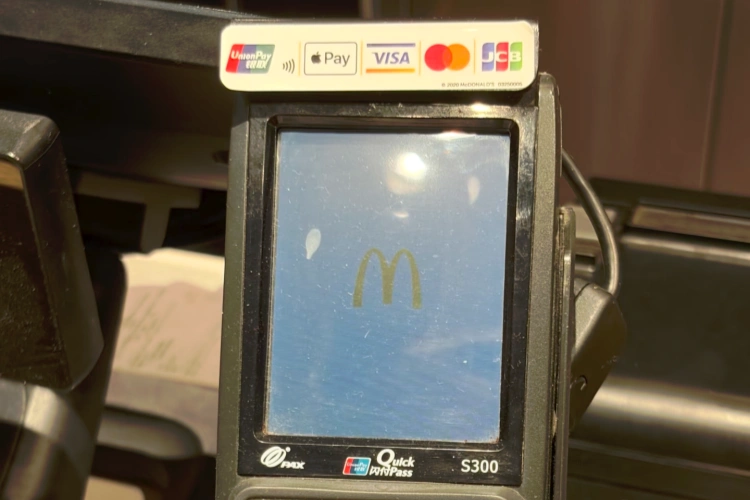
Apple Pay works flawlessly at upscale merchants that accept contactless international cards.
Furthermore, you can use Apple Pay within WeChat Pay’s ecosystem to process transactions in some instances. (Note: Google Pay does not work as Google services are blocked in mainland China).
Understanding Transaction Fees
One thing many travelers don’t realize is that some payments made with international cards may incur additional transaction fees.
To make mobile payments more accessible for foreign visitors, Chinese payment platforms introduced a series of inbound payment improvements starting in 2024. They also occasionally launch fee-waiver promotions and special offers for international users.
That said, it’s still worth understanding the current fee structure before your trip to avoid any surprises and minimize unnecessary charges.
Here’s what you need to know about the current fee structure:
- Transactions under 200 RMB: Completely FREE of transaction fees from the app side;
- Transactions over 200 RMB: A 3% fee is applied by Alipay/WeChat;
- Exchange Rates: These are handled by your home bank or the card issuer.
QuietRoutes Tip: You may need to consult your bank or the card issuer for detailed information before departure.
How to Reduce or Avoid Payment Fees
If you are looking for how to reduce or avoid fees on larger purchases, here are some tips:
1. Take Advantage of Current Fee Waivers
Under Tencent’s latest 2026 initiative, first-time international card users linking to WeChat enjoy a complete waiver on international card processing fees for their first 90 consecutive calendar days (up to 1,000 RMB per day).
2. Split the Bill into Multiple Maximum 200 RMB Transactions
If your total bill is more than 200 RMB, you can simply ask the merchant to split the payments into multiple smaller transactions under 200 RMB each.
For example, if you are buying a meal or souvenir that costs 350 RMB, ask the merchant if they can split the bill into two transactions (e.g., 180 RMB and 170 RMB). Because both are under 200 RMB, you will dodge that 3% fee entirely.
Chinese
我是外国游客。请问可以帮我把这笔付款分成几笔不超过200元人民币的交易吗?谢谢!
Pinyin
Wǒ shì wàiguó yóukè. Qǐngwèn kěyǐ bāng wǒ bǎ zhè bǐ fùkuǎn fēn chéng jǐ bǐ bù chāoguò liǎngbǎi yuán rénmínbì de jiāoyì ma? Xièxie!
English
I’m a foreign visitor. Would it be possible to split this payment into several transactions of no more than RMB 200 each? Thank you!
3. Carry a Small Amount of Cash
For purchases that are only slightly above 200 RMB, using a combination of cash and mobile payment can sometimes reduce fees.
Chinese
我可以先付一部分现金,剩下的用支付宝或微信支付吗?谢谢!
Pinyin
Wǒ kěyǐ xiān fù yí bùfen xiànjīn, shèngxià de yòng Zhīfùbǎo huò Wēixìn Zhīfù zhīfù ma? Xièxie!
English
Could I pay part of the bill in cash and pay the remaining amount with Alipay or WeChat Pay? Thank you!
How to Pay for Didi and Taxis in China
Whether you’re using Didi (China’s Uber) or taking a traditional taxi, mobile payment is by far the easiest option.
Pay for Didi
Most travelers use Didi through either Alipay or WeChat Pay.
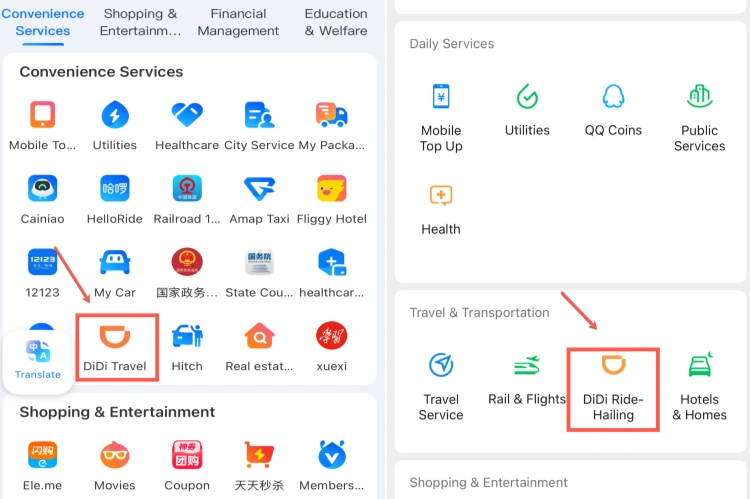
Step 1: Open the Didi Mini Program inside Alipay (More > Didi Travel) or WeChat (Me > Pay and Services > Didi Ride-Hailing).
Step 2: Enter your pickup location and destination.
Step 3: Select your preferred vehicle type.
Step 4: Confirm the ride.
Step 5: Once the trip is complete, the fare will be charged automatically to your linked card through Alipay or WeChat Pay.
There is no need to hand over cash or swipe a card.
Pay for Traditional Taxis
Most taxis in major Chinese cities accept Alipay, WeChat Pay, and sometimes cash.
When you arrive at your destination:
Step 1: Ask the driver for the payment QR code.
Step 2: Open Alipay or WeChat Pay.
Step 3: Scan the QR code.
Step 4: Enter the fare amount and confirm payment.
Some newer taxis display a passenger QR code scanner, allowing the driver to scan your payment code instead.
QuietRoutes Tip: Although cash is still accepted by taxis, many drivers prefer mobile payments. Having Alipay or WeChat Pay set up will make the process much smoother.
How to Pay for the Subway (Metro) in China
China’s metro systems are modern, affordable, and extremely easy to use. In most major cities, you can pay directly using Alipay or WeChat Pay.
Method 1: Use a Transportation QR Code
Most major tourist destinations support mobile payment for public transport, including Beijing, Shanghai, Chengdu, Guangzhou, Shenzhen, Hangzhou, Xi’an, Chongqing, etc.
We recommend using Alipay, which is the most convenient option nationwide.
Step 1: Open Alipay.
Step 2: Tap “Transport” at the top.
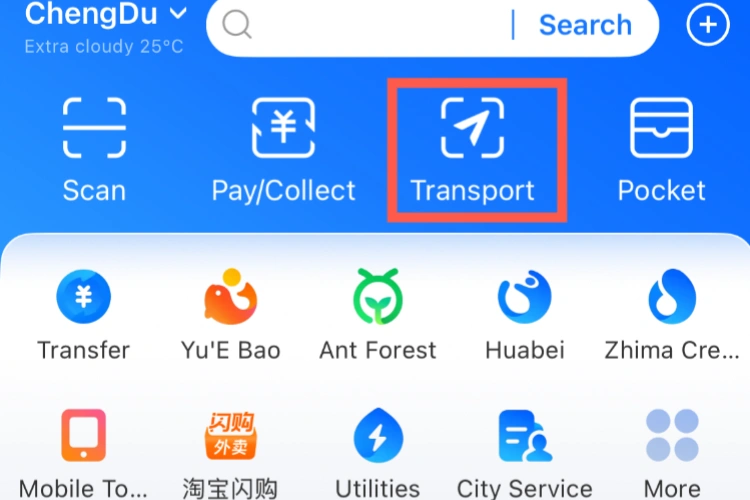
Step 3: Select the city you are visiting.
Step 4: Activate the local transportation QR code.
Passport verification may be required the first time.
Step 5: Scan your QR code at the metro entrance gate.
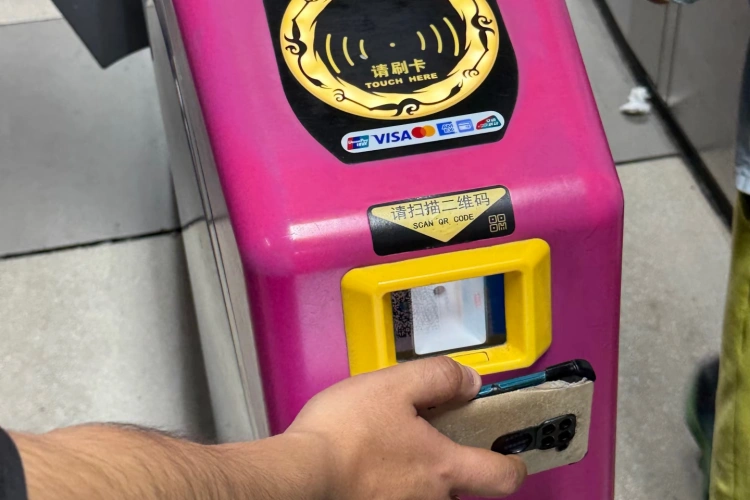
Step 6: Scan again when exiting the station.
The fare will be deducted automatically from your linked payment method.
QuietRoutes Tip: If you’re staying in China for more than a few days, setting up a transportation QR code is much more convenient than other methods.
Method 2: Buy a Single Journey Ticket
If you prefer not to activate a transportation QR code, you can buy physical single journey tickets every time.
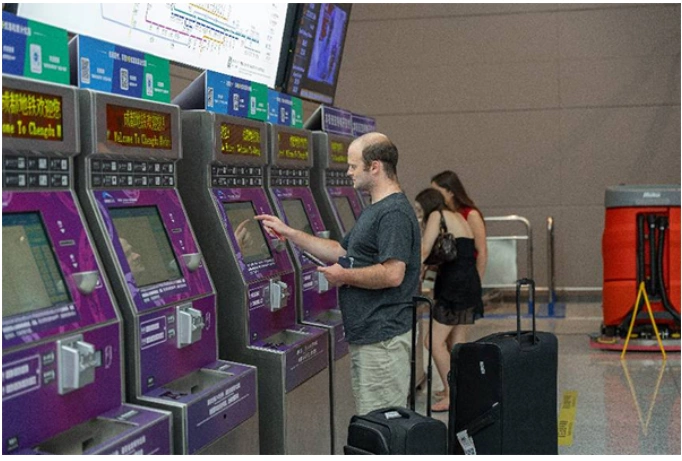
Step 1: Use the ticket machine inside the station.
Step 2: Select your destination.
Step 3: Pay using Alipay, WeChat Pay, or cash (at some stations).
Step 4: Collect your ticket or token.
Step 5: Tap the ticket at the entrance and exit gates.
Method 3: Tap Your International Credit Card Directly
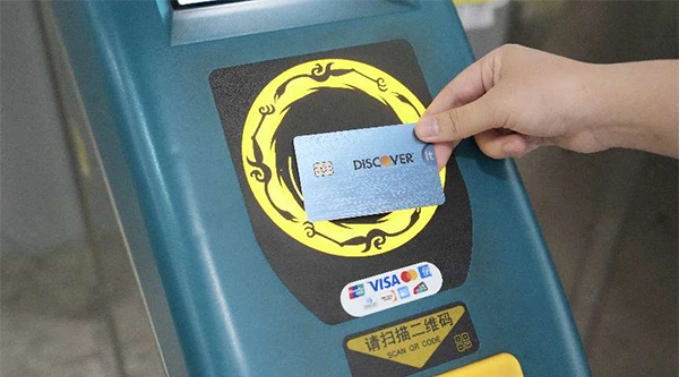
This is one of the newest options for foreign travelers. Some Chinese metro systems, such as those in Beijing, Shanghai, Chengdu, Guangzhou, etc., now allow passengers to enter and exit simply by tapping a contactless international bank card at the fare gates. No app, QR code, or ticket purchase is required.
Supported cards vary by city, but commonly include Visa, Mastercard, American Express, and JCB.
Step 1: Make sure your credit or debit card supports contactless (“tap-to-pay”) transactions.
Step 2: Look for fare gates displaying Visa, Mastercard, American Express, JCB, or UnionPay logos.
Step 3: Tap your card on the reader when entering the station.
Step 4: Tap the same card again when exiting the station.
Step 5: The fare will be calculated automatically and charged directly to your card.
QuietRoutes Tip: Not all metro systems in China currently support direct foreign card payments, so always check local policies before relying on this method. Besides, if you’re visiting multiple cities, we recommend setting up Alipay as your primary payment method and treating contactless bank card payments as a useful backup option.
Final Thoughts
China’s payment system may seem unfamiliar at first, but it quickly becomes one of the easiest parts of traveling in the country.
To help you pay like a local in China, here’s our practical strategy:
Set up Alipay and WeChat Pay before departure, link your international bank card, carry a small amount of cash, and keep a credit card as backup.
With those payment methods ready, you’ll be able to pay for restaurants, taxis, public transportation, attractions, shopping, and almost everything else you’ll encounter during your trip to China.
If you still have any questions regarding payment methods in China, just feel free to contact us. Besides, we’ve also prepared a tutorial file about setting up Alipay and WeChat Pay. You can download PDF directly. TOTALLY FREE.
FAQ
Can foreigners use Alipay in China?
Yes. Foreign visitors can register for Alipay using an overseas phone number and link an international bank card, including Visa, Mastercard, American Express, JCB, Discover, and Diners Club. No Chinese bank account is required.
Can foreigners use WeChat Pay in China?
Yes. WeChat Pay now supports international bank cards from many countries. After creating a WeChat account, you can add your card and complete identity verification using your passport.
Yes. WeChat Pay now supports international bank cards from many countries. After creating a WeChat account, you can add your card and complete identity verification using your passport.
Which is better for tourists: Alipay or WeChat Pay?
Both work well, but we generally recommend Alipay for first-time visitors because its international version is easier to set up and has a more traveler-friendly English interface. Ideally, install both apps before your trip.Both work well, but we generally recommend Alipay for first-time visitors because its international version is easier to set up and has a more traveler-friendly English interface. Ideally, install both apps before your trip.
Do I need a Chinese bank account to pay in China?
No. Foreign tourists can use Alipay and WeChat Pay by linking eligible international credit or debit cards. Opening a Chinese bank account is no longer necessary for most travelers.
Can I use Visa or Mastercard in China?
Yes, but acceptance is limited compared to mobile payments. International cards are usually accepted at major hotels, airports, luxury shopping malls, and some international restaurants. For everyday spending, Alipay and WeChat Pay are much more reliable.
Is cash still accepted in China?
Yes. Merchants are legally required to accept Renminbi (RMB) cash. However, China is largely a cashless society, and many businesses rarely handle cash. We recommend carrying a small amount of RMB for emergencies rather than relying on cash for daily expenses.
How much cash should I bring to China?
Most travelers only need around 200–500 RMB in cash as a backup. If you have Alipay or WeChat Pay set up, you’ll rarely need to use cash in major cities.
Can I use PayPal in China?
At present, U.S. PayPal users can now make payments through PayPal World at participating Weixin Pay (WeChat Pay) merchants. However, Alipay and WeChat Pay remain the primary payment methods in China and offer the broadest acceptance.
Does Apple Pay work in China?
Yes, but mainly at businesses that accept contactless international card payments, such as upscale hotels, luxury stores, and airports. Apple Pay is useful as a backup payment method but cannot match the coverage of Alipay or WeChat Pay.
Does Google Pay work in China?
Google Pay is not widely supported in mainland China and should not be relied upon as a primary payment method. Most travelers use Alipay or WeChat Pay instead.
How do I pay for Didi in China?
The easiest way is through Alipay or WeChat Pay. Both platforms integrate smoothly with Didi and allow you to pay directly using your linked international card.
How do I pay for the metro and buses in China?
In many major cities, you can use Alipay or WeChat Pay to access public transportation. Some cities also allow contactless bank cards or transportation QR codes within the apps.
Are Alipay and WeChat Pay safe?
Yes. Both platforms use advanced security measures, including identity verification, encryption, and payment authentication. They are used daily by hundreds of millions of people in China.
Why was my Alipay or WeChat Pay payment declined?
Common reasons include:
- Your bank blocked the transaction for security reasons.
- The card has not been fully verified.
- The merchant does not accept foreign-linked wallets.
- The payment exceeds your card’s spending limit.
Contact your bank and ensure your card is approved for international transactions before traveling.
Is there a fee for using Alipay or WeChat Pay with a foreign card?
For international cards, transactions above the 200 RMB threshold may incur service fees. Policies can change over time, so check the latest fee information inside the app before your trip.
Can I travel around China without speaking Chinese if I use Alipay or WeChat Pay?
Absolutely. Once your payment apps are set up, paying for restaurants, transportation, attractions, and shopping becomes straightforward. Many international travelers spend weeks in China without speaking more than a few basic Chinese phrases.