When most travelers think of Chengdu, they think of pandas and spicy hotpot. But if you zoom out from the city itself and look at China’s geography, rail network, and western flight map, a different picture appears.
Chengdu is not just a destination. It is one of the most strategically positioned travel hubs in China — especially for travelers interested in jagged peaks of the Himalayas, the emerald waters, the cyberpunk alleys, the ancient Silk Road, and slow travel routes.
In this comprehensive guide, we analyze why Chengdu is—and sometimes isn’t—the right base for your 2026 China itinerary.
Keep reading, you’ll learn:
- Where Chengdu sits on China’s travel map
- What transportation connections it offers in 2026
- Which routes work best from Chengdu
- When it’s smarter to use Beijing or Shanghai instead
- How to plan efficiently without wasting time
Note: This is written from a route-planning perspective — not just a city introduction.

Where Is Chengdu Located on China’s Travel Map?
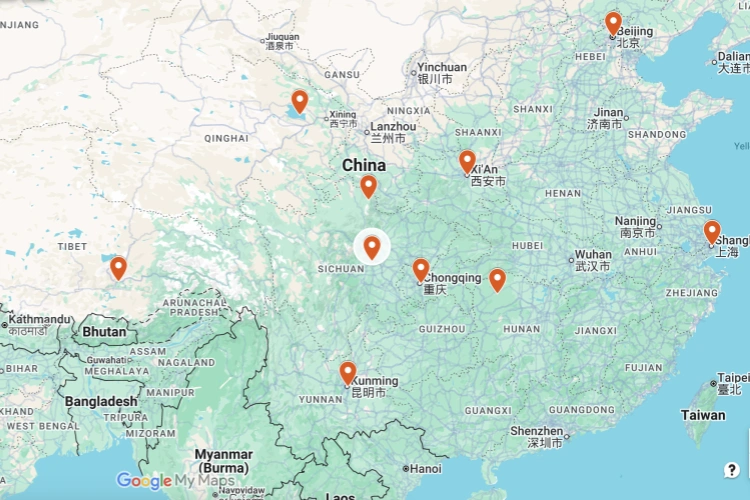
Chengdu is the capital of Sichuan Province in Southwest China. Geographically, it sits at the edge of the Sichuan Basin, with mountains rising toward the Tibetan Plateau in the west and transport corridors stretching eastward toward central China.
On a map, Chengdu forms a bridge between:
- The Tibetan Plateau (west)
- Yunnan and Southeast Asia (south)
- Chongqing and the Yangtze River corridor (east)
- Xi’an and the Silk Road (north)
- Western Sichuan’s alpine valleys (northwest)
Unlike coastal megacities such as Shanghai or political hubs like Beijing, Chengdu sits closer to China’s most dramatic natural regions. That geographic position is what makes it strategically powerful for certain types of trips.
If your focus is mountains, minority cultures, scenic train journeys, nature-focused exploration, or slower travel in western China, Chengdu often makes more sense as a base than any coastal city.
Why Chengdu Is a Major Transportation Hub in 2026
Chengdu’s strength lies in its layered transport system: dual international airports, one of China’s densest high-speed rail connections in the west, and overland access into remote regions.
1. Dual Airports: Tianfu & Shuangliu
Chengdu is one of the few Chinese cities operating two major airports:
Chengdu Tianfu International Airport (TFU)
Opened as the city’s primary international gateway. It handles the lion’s share of long-haul flights from Europe, the Middle East, and North America. With the Metro Line 18 express, you can reach the city center in under 40 minutes despite the distance.
Chengdu Shuangliu International Airport (CTU)
Located significantly closer to the city, CTU now focuses on high-frequency domestic “shuttles” and regional Asian flights.
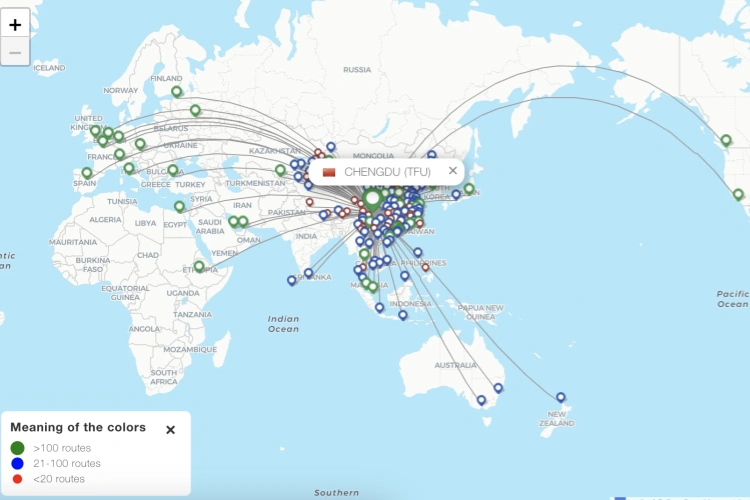
As of 2026, Chengdu offers:
- Direct flights to Southeast Asia (Bangkok, Singapore, Kuala Lumpur)
- Select European routes (seasonal and year-round connections expanding)
- Extensive domestic coverage (almost every major Chinese city)
- Strong western China connectivity (Lhasa, Xining, Kunming, Urumqi)
For travelers entering China from Southeast Asia, Chengdu is often geographically more logical than flying into the east coast and doubling back west.
2. High-Speed Rail Network: Western China’s Core Node
China’s high-speed rail network is the envy of the world, and Chengdu is its Western “Grand Central Station.” By 2026, several key lines have matured:
The “1-Hour Circle”: The Chengdu–Chongqing line now runs “G-series” trains every 15–20 minutes, taking just about 60 minutes to bridge the two megacities.
The Silk Road Connection: The Chengdu–Xi’an HSR line cuts travel time to just 3–4 hours, making it possible to see pandas and the Terracotta Warriors in 1-2 days.
The Southern Link: The line to Kunming (Yunnan) takes about 5–6 hours, to Lanzhou around 5 hours, and to Guiyang about 3 hours, cutting through deep valleys and limestone karst formations that define much of Southwest China’s landscape.
For western-focused itineraries, this density is extremely useful.
3. Road Access to Western Sichuan & Tibet
Chengdu is the primary gateway to:
- Western Sichuan alpine regions
- Tibetan cultural areas within Sichuan
- The Sichuan–Tibet Highway
Many travelers heading to Lhasa either fly from Chengdu or begin overland journeys from here.
In practical terms, if Tibet or highland Sichuan is on your itinerary, Chengdu is almost unavoidable — and strategically ideal.
Best Multi-City Routes Using Chengdu as a Base
The real magic of using Chengdu as a hub is the ability to create “Logical Loops.” Here are the five most efficient route combinations we recommend for 2026.
1. Chengdu – Chongqing – Zhangjiajie
This is one of the most efficient and popular scenic combinations.
Transportation: 1 hour by high-speed train to Chongqing; 4–5 hours onward to Zhangjiajie.
Why this works: This route avoids the backtrack to Beijing or Shanghai, saving you roughly 12 hours of transit time. It also balances between rich food culture and some of China’s most dramatic landscapes.
This route is ideal for 7–12-day travelers.
2. Chengdu – Western Sichuan – Jiuzhaigou
Transportation: This famous “Fairytale Waters” loop used to be a 10-hour bus ride. Now, the Sichuan-Qinghai Railway delivers you from Chengdu to the Jiuzhaigou area in just about 2 hours.
Why this works: Jiuzhaigou National Park is more naturally accessed from Chengdu than from any other major Chinese city.
This combination works well for 6–10 days, especially in late spring or autumn.
3. Chengdu – Lhasa (Tibet)
This pairing is geographically efficient.
Why it works: Chengdu has more flights to Tibet than any other city in China. Furthermore, the 500m altitude of Chengdu is a better “jumping-off” point for acclimatization than sea-level cities.
Expert Tip: Many travelers use Chengdu to process their Tibet Travel Permits through agencies (like us!), as the proximity to the Tibet entry point makes logistics smoother.
4. Chengdu – Yunnan Loop
Travel south from Chengdu to Kunming, then onward to Dali, Lijiang, and Shangri-La.
Why it works: Instead of flying into Yunnan from the east, taking the train from Chengdu lets you see the transition from China’s ethnic-minority landscape. It is a geographically linear progression that makes sense.
5. Chengdu – Xi’an – Silk Road
Travel north from Chengdu to Xi’an, then continue toward Dunhuang, Zhangye, and the Gansu corridor.
Why it works: If you must see the North, starting in the Southwest and moving North is often cheaper and less crowded than the “Beijing-first” approach.
This route is particularly strong for history-focused travelers.
When Chengdu Is NOT the Best Hub (The Honest Truth)
To maintain trust with our travelers, we must admit that Chengdu isn’t the solution for every itinerary.
The “East Coast” Exclusive: If your heart is set on the “Golden Triangle” (Beijing, Xi’an, Shanghai) and you have no interest in the West or mountains, adding Chengdu creates a “V” shape in your logistics that adds 4–6 hours of travel time.
Ultra-Short Trips (3–5 Days): If you only have a few days in China, pick one region. Don’t try to use Chengdu as a hub for a flight to Beijing; you’ll spend half your vacation in airports.
Winter Plateau Restrictions: From late December to February, many routes out of Chengdu into Western Sichuan or Tibet are subject to snow closures. While the city of Chengdu is fine, it ceases to be an effective hub for nature during these months.
Comparison: Chengdu vs. Beijing vs. Shanghai as a Base
All three cities are major and efficient travel hubs for China travel. However, the right choice depends on your route design, travel pace, and personal interests. Each city connects best to different regions of the country, so selecting the right base can significantly improve the flow of your itinerary.
| City | Best For | Limitations |
|---|---|---|
| Chengdu | Western China routes, Tibet access, Sichuan nature, food culture, Chongqing & Zhangjiajie combinations | Far from East China highlights; less efficient for Shanghai/Hangzhou-focused trips |
| Beijing | History lovers, Great Wall access, Northern China, first-time iconic landmarks | Long travel times to Southwest China; less convenient for Yunnan or Tibet routes |
| Shanghai | East China loop (Suzhou, Hangzhou, Huangshan), modern China experience, strong international flight network | Geographically distant from western landscapes; inefficient for plateau or Sichuan travel |
Expert Positioning Insight
If your trip is centered on imperial history and classic bucket-list icons, Beijing is the most efficient starting point.
If you want modern China, water towns, and an easy entry city with global connections, Shanghai works well.
If your itinerary includes mountains, minority regions, highland culture, or western scenic routes, Chengdu is strategically stronger and reduces backtracking across the country.
The smartest hub is not the most famous one — it’s the one aligned with your geography.
Who Should Use Chengdu as Their Hub?
Nature & Photography Lovers: You are within 2 hours of the world’s most beautiful national parks.
Food Explorers: You are in the heart of the only UNESCO City of Gastronomy in China.
Repeat Visitors: If you’ve done the “Beijing-Shanghai” thing, Chengdu is the door to the “Real China.”
Western Explorers: Anyone heading to the “Kham” Tibetan region, Yunnan, or the Silk Road.

Expert Tips for Planning Your Chengdu-Based Trip
The 240-Hour (10-Day) Transit Rule: In 2026, many nationalities can stay in Chengdu for 10 days without a visa if they are transiting to a third country (e.g., London – Chengdu – Bangkok). This is enough time to do a “Chengdu + Jiuzhaigou” or “Chengdu + Tibet” loop.
Station Strategy: Chengdu has multiple train stations. Chengdu East (Dong) is the primary HSR hub. Make sure your hotel is on Metro Line 2 or 7 for the easiest access.
The “Spoke” Strategy: Don’t check out of your Chengdu hotel if you are going to Leshan or Mount Emei for one night. Leave your large bags, take a backpack, and keep your “base” secure.
Avoid “Golden Weeks”: Chengdu is a top domestic destination. Avoid the first weeks of October and May, or your “hub” will become a bottleneck of millions of people.
Final Verdict: Is Chengdu a Smart Travel Base?
The answer is a definitive Yes—if your goal is to see the soul of China.
If you want to experience the dramatic shift from ultra-modern urbanism to ancient mountain traditions, there is no better starting point. Chengdu offers the infrastructure of the future with the culture of the past, acting as the perfect “Quiet Route” into the heart of the continent.